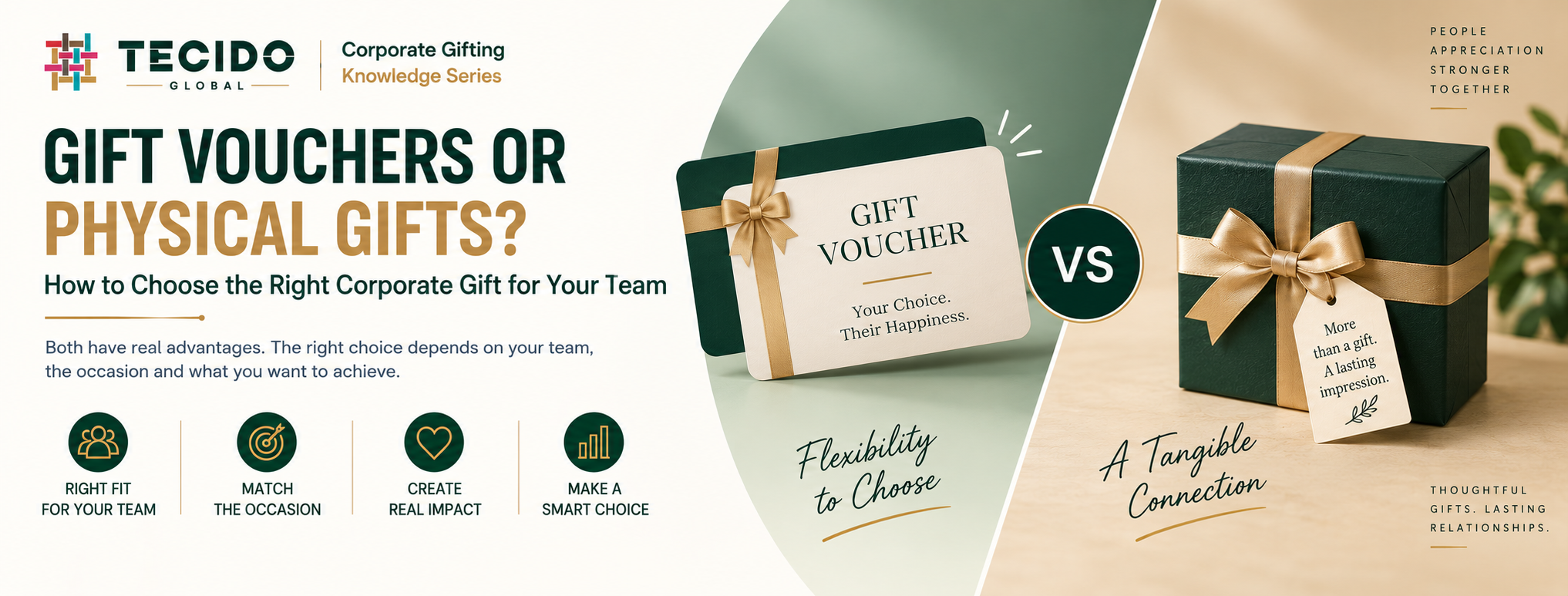
Gift Vouchers or Physical Gifts? How to Choose the Right Corporate Gift for Your Team
Should your company give gift vouchers or physical gifts to employees and clients? We break down the pros, cons, and ideal use cases — so your next gifting decision is the right one.
It is one of the most common decisions in corporate gifting — and one of the most under-thought. Do you send a gift voucher or a physical gift? Both approaches have genuine merit. Both have real limitations. And choosing the wrong one for the wrong context can make a well-intentioned gesture land far below its potential.
This post gives you a clear, practical framework for making the right call — based on the occasion, the relationship, and what you are trying to achieve.
The Case for Gift Vouchers
Gift vouchers — whether physical cards or digital codes redeemable on platforms like Amazon, Flipkart, Swiggy, or curated brand portals — solve a specific and genuine problem in corporate gifting: the diversity of preferences across large, varied teams.
When your workforce spans 20 cities, multiple age groups, varied dietary requirements, and different lifestyles, choosing a single physical gift that resonates with everyone is genuinely difficult. A voucher sidesteps this problem entirely by placing the choice in the recipient's hands.
Gift vouchers work best when:
• The team is large and diverse: different roles, locations, and life stages make a single physical gift impractical
• Speed is critical: digital vouchers can be distributed to thousands of employees in minutes — ideal for last-minute recognition or urgent Diwali programmes
• The occasion is performance-based: sales incentives, spot rewards, and points-based recognition where flexibility and perceived fairness matter more than physical delight
• Compliance documentation is needed: vouchers with declared face values are simpler to document for GST and income tax than physical gifts at volume
The limitation is real, however. A voucher — however generous — rarely creates the emotional impact of something carefully chosen and beautifully presented. It communicates convenience more than consideration. And in many gifting contexts, the signal matters as much as the value.
The Case for Physical Gifts
A thoughtfully curated, well-presented physical gift does something a voucher cannot: it creates a tangible, lasting moment. The weight of the package. The texture of the packaging. The unboxing experience. The product sitting on a desk or kitchen counter every day. These sensory touchpoints generate emotional memory and brand association in ways that a digital code simply cannot replicate.
Physical gifts work best when:
• The occasion is relational: new hire onboarding, work anniversaries, client appreciation, and Diwali are all moments where the physical nature of a gift carries the full emotional weight of the gesture
• Brand visibility matters: a quality branded bottle or a premium laptop sleeve keeps your company visible in the recipient's daily environment for months — sometimes years
• Personalisation is possible: a name-engraved notebook, a handcrafted item with a story card, or a product chosen to reflect what the giver knows about the recipient — personalised physical gifts generate the strongest emotional ROI in any gifting programme
• The relationship is a key one: for tier-1 clients, senior employees, and strategic partners, a voucher communicates transactional convenience; a considered physical gift communicates genuine investment in the relationship
The practical limitation: physical gifts require more planning, more lead time, and more upfront product decisions. At scale, they also need a reliable partner who can manage quality, customisation, and pan-India delivery consistently.
When the Best Answer Is Both
The most effective corporate gifting programmes in Indian B2B companies increasingly combine physical and digital elements — what is called phygital gifting. A premium physical kit arrives at the employee's home; inside, a QR code redeems a digital experience, a brand-of-choice voucher, or a personalised message from leadership.
This approach captures the strengths of both: the emotional warmth of the physical unboxing, the flexibility of the digital element, and the personalisation that transforms the experience from mass-produced to individual. For hybrid and distributed teams, this model also ensures that every recipient — regardless of location — has an equally engaging interaction with the gift.
A Practical Decision Framework: Which to Choose, and When
• New hire welcome kit: physical gift — always. The onboarding moment requires tangible, branded warmth that a voucher cannot deliver
• Diwali for the full team: physical gift for core team; a supplementary voucher is acceptable for very large, geographically dispersed organisations where personalisation at volume is not feasible
• Client appreciation gift: physical gift — a voucher sent to a client signals that you did not invest the thought their relationship deserves
• Performance recognition or spot reward: gift voucher — speed, flexibility, and perceived fairness all favour digital rewards for merit-based programmes
• Work anniversary (5 years or more): physical gift at premium tier — this is the milestone where a lasting, considered gift makes the most impact on long-term retention
• Large event giveaway (500+ attendees): voucher or a single quality branded item — logistics and cost per impression favour simplicity at this scale
"A gift voucher says we thought of you. A physical gift says we thought about you. Both have a place in a B2B gifting programme — but only one creates the kind of moment that genuinely strengthens a relationship." — Priti Bhandari, Co-Founder, Tecido Global
Tecido offers curated physical gift programmes and digital gift voucher solutions for B2B companies across India. Contact us at info@tecidoglobal.com or +91 98924 67276 to find the right approach for your team.
Tecido Global
Your trusted partner for corporate gifting and branded merchandise. We are a team of passionate, creative individuals helping brands build stronger identities through thoughtful, high-quality merchandise that leaves a lasting impression. From concept to doorstep — end-to-end, on time, every single time.
Contact Info
- info@tecidoglobal.com
- (+91) 98924 67276
- (+91) 93213 02123
-
VERDE TECIDO GLOBAL LLP
20th Floor, Commerz II, Oberoi Garden City,
Off Western Express Highway, Goregaon (E),
Mumbai - 400063
GST: 27AAZFV9492L1ZP
MSME Reg.: UDYAM-MH-33-0649603


© 2026 Tecido Global | All Rights Reserved