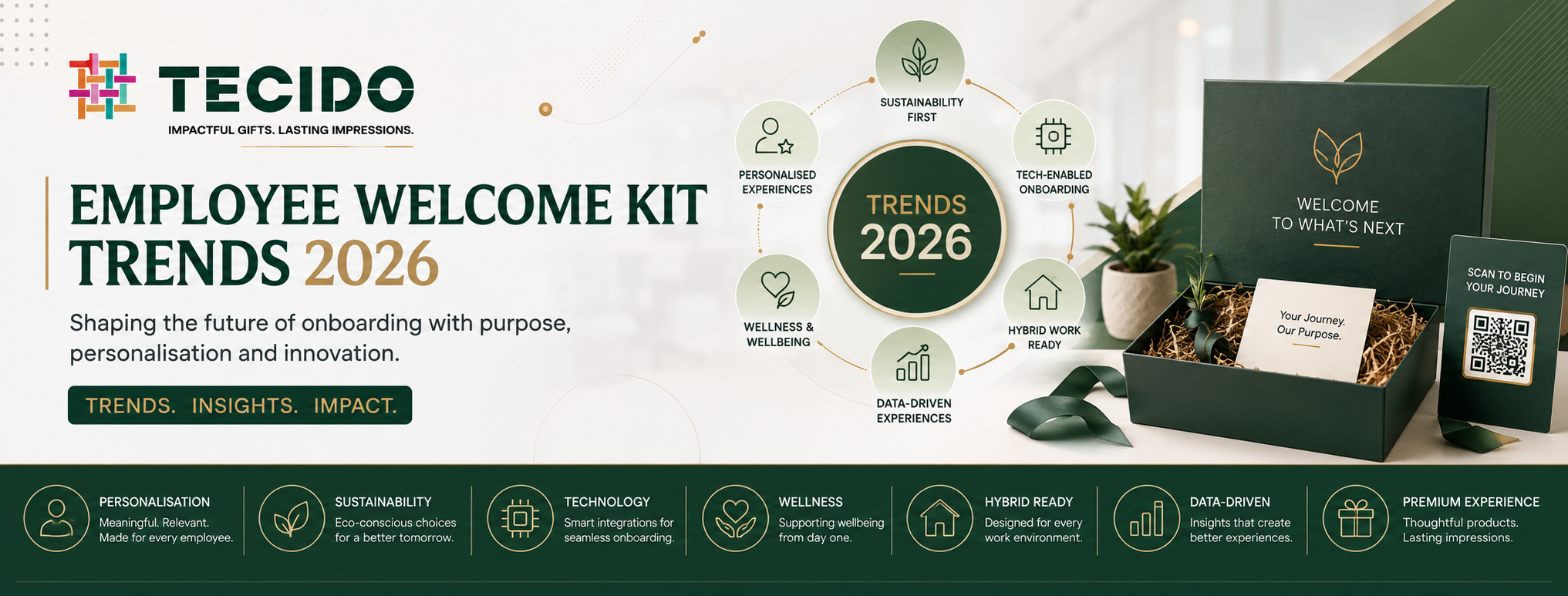
Employee Welcome Kit Trends 2026: 12 Onboarding Innovations Every HR & Procurement Leader Should Know
Explore the top Employee Welcome Kit trends for 2026, from AI-enabled onboarding and sustainable gifting to hybrid welcome kits, personalised experiences, and smart technology integration.
Employee Welcome Kit Trends 2026 | The Future of Employee Onboarding
Quick Summary
The employee welcome kit has evolved from a simple collection of branded merchandise into a strategic tool for employer branding, employee engagement, and organisational culture.
In 2026, organisations are rethinking onboarding through sustainability, personalisation, technology, hybrid work, and data-driven employee experiences.
This article explores the twelve biggest Employee Welcome Kit trends shaping the future of onboarding and what HR, Procurement, and Business Leaders should prioritise to create memorable first impressions.
Introduction
Employee expectations have changed dramatically.
New hires today expect more than a branded notebook and company T-shirt. They expect an onboarding experience that reflects the organisation's culture, values, technology, and commitment to employee wellbeing.
At the same time, organisations are competing harder than ever for skilled talent.
The result?
The Employee Welcome Kit has become an important extension of employer branding—not merely a welcome gift.
Leading organisations are now designing onboarding experiences that begin before Day One and continue throughout the first ninety days.
As we move through 2026, several clear trends are shaping the future of employee welcome kits.
1. Personalisation Becomes the Standard
Generic welcome kits are disappearing.
Employees increasingly expect experiences designed specifically for them.
Personalisation now includes:
- Employee name on products
- Personalised welcome letters
- Manager messages
- Department-specific resources
- Role-based products
- Regional customisation
- Language preferences
Employees appreciate thoughtful experiences more than expensive products.
2. Sustainability Moves from "Nice-to-Have" to Business Priority
ESG goals are influencing procurement decisions across industries.
Companies are replacing disposable merchandise with environmentally responsible alternatives.
Popular sustainable additions include:
- Recycled notebooks
- Cork accessories
- Bamboo desktop products
- Organic cotton apparel
- Stainless steel drinkware
- Seed paper stationery
- Reusable packaging
The focus is shifting from eco-friendly products to sustainable onboarding experiences.
3. Technology-Enabled Welcome Kits
Physical gifts are now being combined with digital experiences.
Modern welcome kits increasingly include:
- QR-enabled onboarding
- NFC welcome cards
- Digital employee handbooks
- AI onboarding assistants
- Learning platforms
- Interactive induction journeys
Technology simplifies onboarding while improving engagement and consistency.
4. Hybrid-Friendly Welcome Kits
Hybrid work is no longer temporary.
Many organisations now onboard employees across multiple cities and countries.
As a result, welcome kits are designed for employees who may never visit the office during their first week.
Common additions include:
- Home office accessories
- Wireless chargers
- Laptop stands
- Video conferencing essentials
- Ergonomic products
- Digital onboarding guides
Consistency is becoming more important than location.
5. Wellness Takes Centre Stage
Employee wellbeing is becoming a business priority.
Modern welcome kits increasingly include products that encourage healthier work habits.
Examples include:
- Wellness journals
- Aromatherapy products
- Herbal teas
- Fitness bands
- Yoga accessories
- Healthy snacks
- Desk plants
- Mindfulness resources
Organisations are recognising that employee wellbeing begins on Day One.
6. Premium Packaging Creates Premium Experiences
Packaging is becoming as important as the products themselves.
The unboxing experience significantly influences first impressions.
Leading companies are investing in:
- Magnetic gift boxes
- Rigid premium packaging
- Minimalist branding
- Reusable boxes
- Elegant inserts
- Sustainable presentation materials
Employees often share premium packaging on social media, extending employer brand visibility.
7. Industry-Specific Welcome Kits
One-size-fits-all onboarding is gradually disappearing.
Organisations now customise welcome kits based on industry requirements.
Examples include:
Technology
- Wireless accessories
- Smart gadgets
- Digital onboarding tools
Manufacturing
- Safety essentials
- Field accessories
- Utility-focused products
Healthcare
- Wellness products
- Professional organisers
- Practical daily essentials
Financial Services
- Executive stationery
- Premium organisers
- Elegant desk accessories
Industry relevance improves perceived value.
8. Employer Branding Through Storytelling
Employees want to understand why the organisation exists—not just what it sells.
Modern welcome kits now include:
- Founder stories
- Company milestones
- Employee success stories
- Vision and mission booklets
- CSR initiatives
- Sustainability commitments
- Community programmes
The welcome kit becomes the first chapter of the employee's journey.
9. Smart Logistics & Global Fulfilment
As organisations hire talent across multiple geographies, logistics has become part of the onboarding experience.
Companies increasingly expect:
- Multi-location delivery
- Global fulfilment
- Shipment tracking
- Scheduled deliveries
- Inventory management
- Regional customisation
Reliable delivery is becoming a competitive advantage.
10. AI-Powered Onboarding
Artificial Intelligence is beginning to transform onboarding.
AI now supports:
- Frequently asked questions
- Learning recommendations
- Document assistance
- HR support
- Policy navigation
- Employee guidance
Rather than replacing HR teams, AI enables them to provide faster and more consistent support.
11. Data-Driven Employee Experience
Forward-thinking organisations no longer evaluate welcome kits by cost alone.
Instead, they measure business outcomes.
Key metrics include:
- Employee engagement
- Onboarding satisfaction
- Time-to-productivity
- First-year retention
- Employer branding reach
- Employee referrals
The welcome kit is becoming a measurable business investment rather than an administrative expense.
12. Premium Experiences Over More Products
Perhaps the biggest trend of all is this:
Less—but better.
Instead of filling welcome kits with numerous promotional items, organisations are investing in fewer, higher-quality products.
Employees consistently prefer:
- Premium backpacks
- Elegant apparel
- Technology accessories
- Personalised products
- Sustainable materials
- Luxury packaging
Quality creates stronger emotional impact than quantity.
What These Trends Mean for HR and Procurement
The role of HR and Procurement is changing.
Today's onboarding programmes require collaboration across multiple functions, including:
- Human Resources
- Procurement
- Marketing
- Employer Branding
- IT
- Operations
Successful organisations are designing onboarding experiences—not merely purchasing products.
This shift requires suppliers who understand branding, logistics, personalisation, sustainability, and technology.
Preparing for the Future
The employee welcome kit of 2026 is no longer simply a gift.
It is:
- an employer branding tool
- a culture-building initiative
- an employee engagement strategy
- a technology platform
- a sustainability statement
- an onboarding accelerator
Organisations that embrace these trends will create stronger first impressions, improve employee engagement, and reinforce their employer brand from the very beginning.
Expert Insight
"The future of employee onboarding isn't about adding more products to a welcome kit—it's about creating more meaningful experiences. The organisations that lead in 2026 will be those that combine thoughtful design, personalisation, sustainability, and technology to make every new employee feel genuinely welcomed from the very first interaction."
— Priti Bhandari, Founder & CEO, Tecido Global
Frequently Asked Questions
What is the biggest Employee Welcome Kit trend in 2026?
The biggest trend is the shift from generic product-based kits to personalised, technology-enabled onboarding experiences that strengthen employer branding and employee engagement.
Are sustainable welcome kits becoming the norm?
Yes. Sustainability has become a major procurement and employer branding priority, with organisations increasingly choosing eco-friendly products and reusable packaging.
How is AI influencing onboarding?
AI is helping employees access HR information, complete onboarding tasks, navigate policies, and receive personalised support throughout their onboarding journey.
Should companies redesign their welcome kits every year?
Not necessarily. However, organisations should review their welcome kit strategy annually to ensure it reflects changing employee expectations, workplace trends, and business priorities.
Conclusion
The Employee Welcome Kit is no longer a box of branded merchandise—it is a strategic investment in employee experience.
As organisations continue embracing hybrid work, digital transformation, sustainability, and employer branding, onboarding will become increasingly personalised, measurable, and technology-driven.
The trends shaping 2026 point towards one clear direction: the most successful welcome kits will be those that create meaningful experiences rather than simply deliver products.
About Tecido Global
At Tecido Global, we help organisations stay ahead of workplace trends by designing future-ready Employee Welcome Kits that combine premium products, sustainable materials, personalised branding, technology integration, and seamless pan-India fulfilment. From startups to Fortune 500 companies, we create onboarding experiences that leave lasting impressions.
Ready to Future-Proof Your Employee Onboarding?
The best welcome kits don't just welcome employees—they showcase your culture, strengthen your employer brand, and prepare your workforce for success.
Partner with Tecido Global (a Mumbai-based corporate gifting solutions company) to create Employee Welcome Kits that reflect the trends shaping the future of work.
Tecido Global
Your trusted partner for corporate gifting and branded merchandise. We are a team of passionate, creative individuals helping brands build stronger identities through thoughtful, high-quality merchandise that leaves a lasting impression. From concept to doorstep — end-to-end, on time, every single time.
Contact Info
- info@tecidoglobal.com
- (+91) 98924 67276
- (+91) 93213 02123
-
VERDE TECIDO GLOBAL LLP
20th Floor, Commerz II, Oberoi Garden City,
Off Western Express Highway, Goregaon (E),
Mumbai - 400063
GST: 27AAZFV9492L1ZP
MSME Reg.: UDYAM-MH-33-0649603


© 2026 Tecido Global | All Rights Reserved