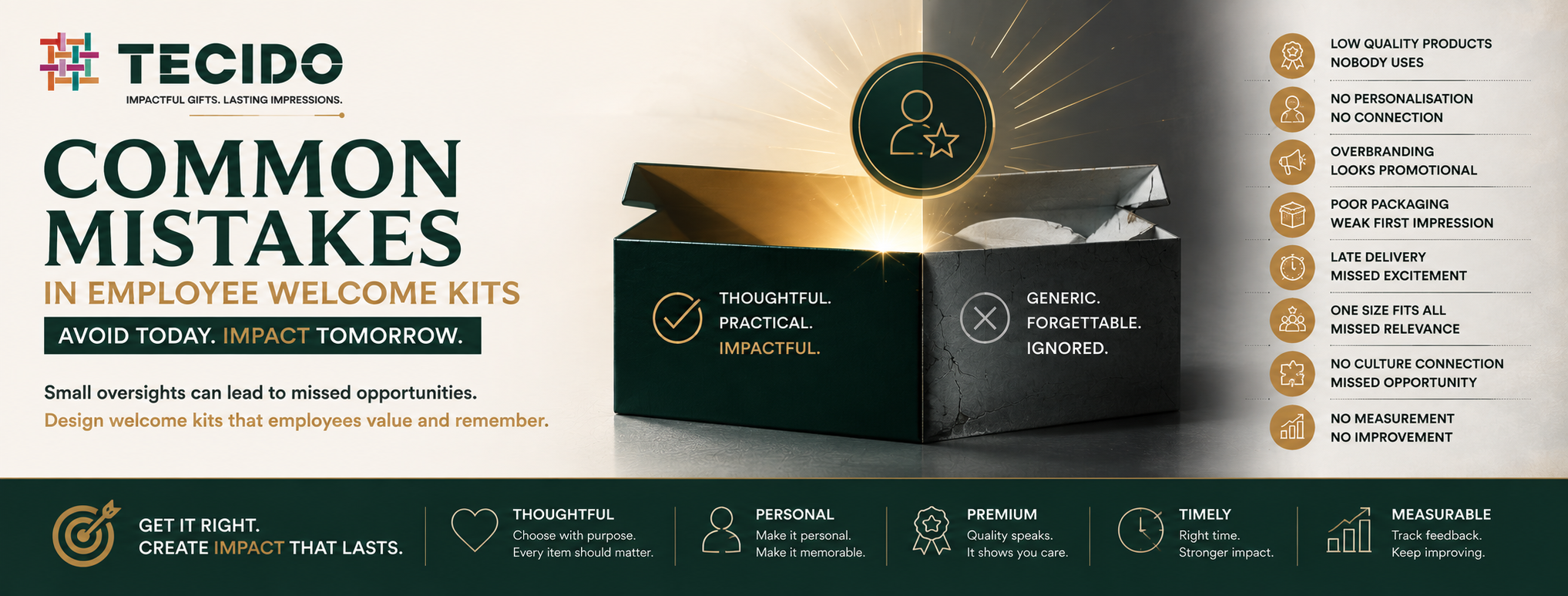
Common Mistakes Companies Make While Designing Employee Welcome Kits (And How to Avoid Them)
Discover the most common mistakes companies make while designing employee welcome kits and learn how to create onboarding experiences that improve engagement, retention, and employer branding.
Common Employee Welcome Kit Mistakes | How to Design Better Onboarding Kits
Quick Summary
A well-designed employee welcome kit creates excitement, builds belonging, and strengthens employer branding from day one. Unfortunately, many organisations unknowingly reduce its impact through poor planning, generic products, inconsistent branding, or delayed delivery.
This article highlights the most common mistakes companies make while designing employee welcome kits and shares practical ways to avoid them—helping HR, Procurement, and Leadership teams create onboarding experiences that employees genuinely remember.
Introduction
An employee welcome kit is often the very first tangible interaction a new hire has with your organisation.
Before attending induction sessions, meeting colleagues, or logging into company systems, employees form opinions based on what they receive—and how they receive it.
A thoughtfully curated welcome kit communicates professionalism, culture, and care.
A poorly planned one sends exactly the opposite message.
Surprisingly, many organisations invest significant budgets in onboarding but overlook details that determine whether the welcome kit creates excitement or disappointment.
The good news?
Most of these mistakes are completely avoidable.
Let's explore the most common pitfalls—and how to create welcome kits that leave a lasting impression.
Mistake 1: Treating the Welcome Kit as Just Another Procurement Purchase
Many organisations focus almost entirely on unit pricing.
Questions typically become:
- Which vendor is the cheapest?
- Can we reduce the budget?
- Can we remove one more item?
While cost matters, onboarding is not merely a procurement exercise.
A welcome kit is part of your employer brand.
Every product, colour, message, and packaging choice reflects how employees perceive your organisation.
The objective should be creating value—not simply reducing costs.
Best Practice
Evaluate welcome kits based on:
- employee experience
- quality
- usability
- branding
- presentation
- long-term impact
The cheapest kit is rarely the one employees remember.
Mistake 2: Filling the Kit with Promotional Products Nobody Uses
One of the biggest mistakes is including products simply because they are inexpensive.
Employees rarely appreciate:
- low-quality keychains
- plastic pens
- generic mouse pads
- poor-quality mugs
- novelty promotional items
These products often remain unused or discarded.
Instead, curate products employees genuinely use every day.
Examples include:
- premium notebooks
- insulated bottles
- backpacks
- laptop sleeves
- wireless chargers
- desk organisers
- apparel
- travel accessories
Useful products create lasting brand visibility.
Mistake 3: Ignoring Personalisation
Nothing feels less welcoming than opening a box designed for "any employee."
Personalisation transforms a standard welcome kit into a memorable experience.
Simple additions can make a significant difference:
- employee name
- personalised welcome letter
- manager's handwritten note
- department-specific message
- customised onboarding guide
These thoughtful details create emotional connection far beyond the monetary value of the products.
People remember how they were made to feel.
Mistake 4: Overbranding Every Product
Branding is important—but excessive branding can make the welcome kit resemble a promotional giveaway rather than a premium gift.
Not every product needs an oversized company logo.
Subtle branding often feels more premium.
Consider:
- tone-on-tone branding
- laser engraving
- debossing
- elegant embroidery
- minimal logo placement
Employees are far more likely to use products that look stylish rather than promotional.
Mistake 5: Poor Packaging
Presentation shapes perception.
Even premium products lose their appeal if they arrive in ordinary cardboard boxes with little attention to presentation.
A premium unboxing experience should include:
- rigid gift box
- organised compartments
- tissue paper
- branded sleeve
- personalised message
- premium finishing
Remember—
Employees experience the packaging before they experience the products.
First impressions begin the moment the box is opened.
Mistake 6: Delivering the Kit Too Late
Timing matters.
Some organisations distribute welcome kits weeks after employees join.
By then, the excitement of Day One has passed.
Ideally, employees should receive their welcome kit:
- before joining
- on their first working day
- or waiting at their workstation
For remote employees, timely home delivery creates the same emotional impact.
A delayed welcome feels like an afterthought.
Mistake 7: Creating the Same Kit for Everyone
Every employee does not perform the same role.
A sales professional, software engineer, factory supervisor, and CXO have different requirements.
A single standard kit often misses opportunities to provide role-specific value.
Consider creating different collections for:
- campus hires
- experienced professionals
- sales teams
- technology teams
- leadership
- international employees
- remote employees
Role-based customisation significantly enhances perceived value.
Mistake 8: Forgetting Company Culture
The welcome kit should communicate your organisation's identity.
Ask yourself:
"What story does this box tell?"
If your company values innovation, sustainability, collaboration, or customer obsession, those values should be visible throughout the experience.
Culture can be reflected through:
- welcome booklet
- founder's message
- values cards
- sustainability initiatives
- employee stories
- visual design
- packaging language
The welcome kit becomes a physical extension of your organisational culture.
Mistake 9: Choosing Products Without Practical Value
Beautiful products mean little if employees never use them.
Always ask:
"Will this employee still be using this six months from now?"
Products with high utility create ongoing brand visibility while providing genuine value.
Practical products consistently outperform novelty items.
Mistake 10: Not Measuring Success
Many organisations never evaluate whether their welcome kits actually improve onboarding.
Instead of treating welcome kits as a one-time purchase, measure outcomes.
Track:
- onboarding feedback
- employee satisfaction
- engagement scores
- first-year retention
- employer branding
- employee referrals
- social media mentions
Data helps refine future onboarding programmes and maximise ROI.
The Cost of Getting It Wrong
A poorly executed welcome kit may seem like a small oversight, but it can influence how employees perceive your organisation from the very beginning.
The consequences often include:
- weaker first impressions
- reduced excitement
- lower engagement
- inconsistent employer branding
- missed opportunities for employee advocacy
- lower perceived organisational value
Conversely, organisations that invest in thoughtful onboarding often experience stronger employee engagement and better long-term retention.
The Formula for a Great Welcome Kit
The best employee welcome kits are built around five simple principles:
Thoughtful
Every item should have a purpose.
Useful
Choose products employees will actually use.
Personal
Create emotional connection through customised messaging.
Premium
Quality reflects how your organisation values its people.
Timely
Deliver the experience when excitement is highest.
When these five principles come together, the welcome kit becomes far more than a collection of branded products—it becomes the beginning of a meaningful employee journey.
Expert Insight
"The biggest mistake companies make isn't spending too little on welcome kits—it's spending without purpose. Every product, every message, and every detail should reinforce your culture and make employees feel genuinely valued from day one."
— Liane Alfred, Manager – Business Development, Tecido Global
Frequently Asked Questions
What is the biggest mistake companies make with welcome kits?
Treating them as a procurement purchase instead of an employee experience. A welcome kit should strengthen culture, engagement, and employer branding—not simply distribute promotional merchandise.
How many products should a welcome kit contain?
Quality is more important than quantity. Most premium welcome kits contain 5–8 thoughtfully selected products that employees genuinely use.
Is personalisation necessary?
Yes. Even a personalised welcome letter or employee name significantly enhances the emotional impact of the onboarding experience.
Should every employee receive the same welcome kit?
Not necessarily. Organisations often achieve better outcomes by creating different welcome kits for executives, remote employees, campus hires, sales teams, and technical roles.
Conclusion
Employee welcome kits are one of the simplest ways to create a memorable first impression—but only when they are designed with intention.
Avoiding common mistakes such as poor product selection, generic branding, delayed delivery, and lack of personalisation can dramatically improve the onboarding experience.
The best welcome kits don't just welcome employees—they introduce them to your culture, reinforce your values, and make them feel like they truly belong from the very first day.
About Tecido Global
At Tecido Global, Mumbai, we help organisations design premium employee welcome kits that combine thoughtful product curation, elegant packaging, personalised branding, and seamless pan-India fulfilment. Whether you're onboarding 20 employees or 20,000, we create welcome experiences that strengthen employer branding, improve employee engagement, and leave lasting impressions.
Ready to Design a Welcome Kit Your Employees Will Never Forget?
Your onboarding experience begins long before the first meeting.
Partner with Tecido Global to create thoughtfully curated Employee Welcome Kits that inspire belonging, reflect your culture, and make every new employee feel valued from day one.
Tecido Global
Your trusted partner for corporate gifting and branded merchandise. We are a team of passionate, creative individuals helping brands build stronger identities through thoughtful, high-quality merchandise that leaves a lasting impression. From concept to doorstep — end-to-end, on time, every single time.
Contact Info
- info@tecidoglobal.com
- (+91) 98924 67276
- (+91) 93213 02123
-
VERDE TECIDO GLOBAL LLP
20th Floor, Commerz II, Oberoi Garden City,
Off Western Express Highway, Goregaon (E),
Mumbai - 400063
GST: 27AAZFV9492L1ZP
MSME Reg.: UDYAM-MH-33-0649603


© 2026 Tecido Global | All Rights Reserved