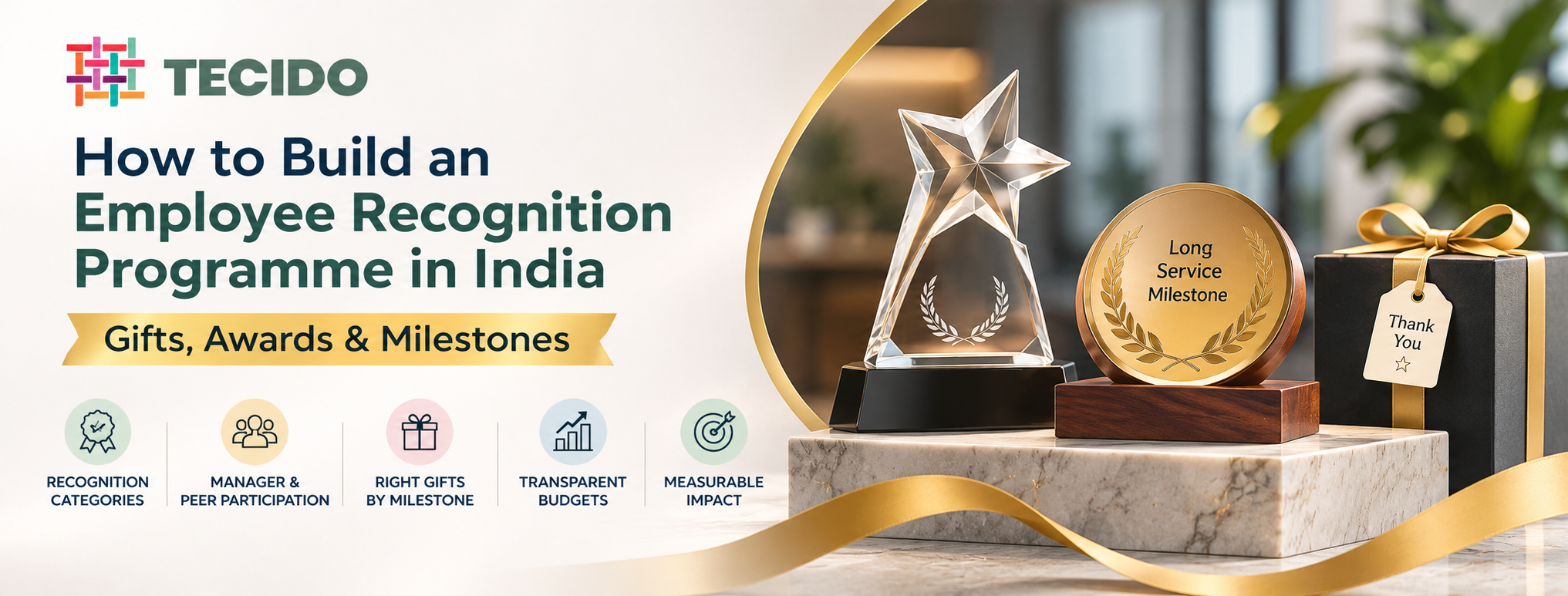
How to Build an Employee Recognition Programme: Gifts, Awards & Milestones
Learn how to build an employee recognition programme in India using clear milestones, gifts, awards, manager recognition, budgets and measurable processes.
Quick Answer
An effective employee recognition programme combines frequent low-friction appreciation with meaningful milestone recognition. Define behaviours and achievements to recognise, create transparent categories and budget bands, give managers simple tools, use gifts or awards where they add value, and measure participation, timeliness and employee feedback rather than only the number of gifts distributed.
Introduction
Recognition is broader than gifting. A gift can make appreciation tangible, but the programme needs clear criteria, fair access and timely manager behaviour. Indian organisations can combine peer recognition, manager appreciation, performance awards, service milestones and company-wide moments within one structured framework.
Define what the company wants to recognise
Start with behaviours and outcomes linked to culture and business priorities: customer impact, collaboration, innovation, safety, performance, mentoring, service and values.
Avoid categories so vague that managers cannot explain why someone won.
Build recognition layers
Use everyday appreciation for small wins, monthly or quarterly recognition for visible contributions, and milestone awards for service, promotions or exceptional performance.
Not every layer needs a physical gift. Messages, visibility, certificates, experiences and gifts can be combined.
Create transparent budget bands
Set value ranges by recognition type rather than negotiating each gift separately. This improves fairness and makes procurement predictable.
Calculate landed cost including branding, packaging, tax and freight for physical rewards.
Choose gifts by milestone
Spot recognition can use compact useful gifts or vouchers. Quarterly awards can use better lifestyle, tech or travel products. Long-service milestones can justify personalised mementos, premium gifts or experiences.
The gift should increase in meaning, not merely item count.
Manager and peer participation
Managers need simple nomination and approval processes. Peer recognition can broaden visibility beyond reporting lines, but it should not become a popularity contest.
Provide examples of qualifying behaviours and require a short reason for recognition.
Personalisation and communication
Use the employee’s name, achievement and a specific message. Public recognition should respect employee preferences; some people value private appreciation more.
For distributed teams, coordinate delivery and announcement timing.
Measure programme quality
Track participation across departments, time from achievement to recognition, manager adoption, distribution errors and employee feedback. Review whether the same people or teams are repeatedly overlooked.
Recognition quality is more important than gift volume.
Tecido Global Expert View
Employee recognition works best as a system, not a collection of unrelated gifts. Our view is that companies should first define the behaviours and milestones they want to recognise, then assign appropriate recognition levels, gifts and communication. A one-year anniversary should not necessarily look like a ten-year milestone, and a spot award should not feel identical to a major achievement award. Consistency creates fairness, while personalisation creates meaning. Tecido Global sees gifting as one part of the recognition experience—not the whole programme, but an important physical reminder of it.
Frequently Asked Questions
What should an employee recognition programme include?
Clear recognition categories, transparent criteria, manager and peer mechanisms, budget bands, communication, appropriate rewards and measurement.
How often should employees be recognised?
Recognition should be timely rather than limited to annual cycles. Different layers can operate continuously, monthly, quarterly and at milestones.
Are gifts necessary for employee recognition?
No. Recognition can include praise, visibility, certificates, experiences and growth opportunities. Gifts are useful when they make important moments tangible.
How can companies keep recognition fair?
Use clear criteria, monitor participation by team and manager, require reasons for nominations and review patterns for bias or under-recognition.
Conclusion
A recognition programme works when employees understand what is valued and managers can acknowledge it quickly and fairly. Use gifts and awards selectively to strengthen meaningful moments, not as a substitute for good recognition behaviour.
About Tecido Global
Tecido Global helps Indian companies curate and execute corporate gifting and custom merchandise programmes across employee engagement, onboarding, events, client gifting, leadership gifting and recognition. The approach combines sourcing, branding, packaging, quality control and delivery through one coordinated team.
Tecido Global
Your trusted partner for corporate gifting and branded merchandise. We are a team of passionate, creative individuals helping brands build stronger identities through thoughtful, high-quality merchandise that leaves a lasting impression. From concept to doorstep — end-to-end, on time, every single time.
Contact Info
- info@tecidoglobal.com
- (+91) 98924 67276
- (+91) 93213 02123
-
VERDE TECIDO GLOBAL LLP
20th Floor, Commerz II, Oberoi Garden City,
Off Western Express Highway, Goregaon (E),
Mumbai - 400063
GST: 27AAZFV9492L1ZP
MSME Reg.: UDYAM-MH-33-0649603


© 2026 Tecido Global | All Rights Reserved