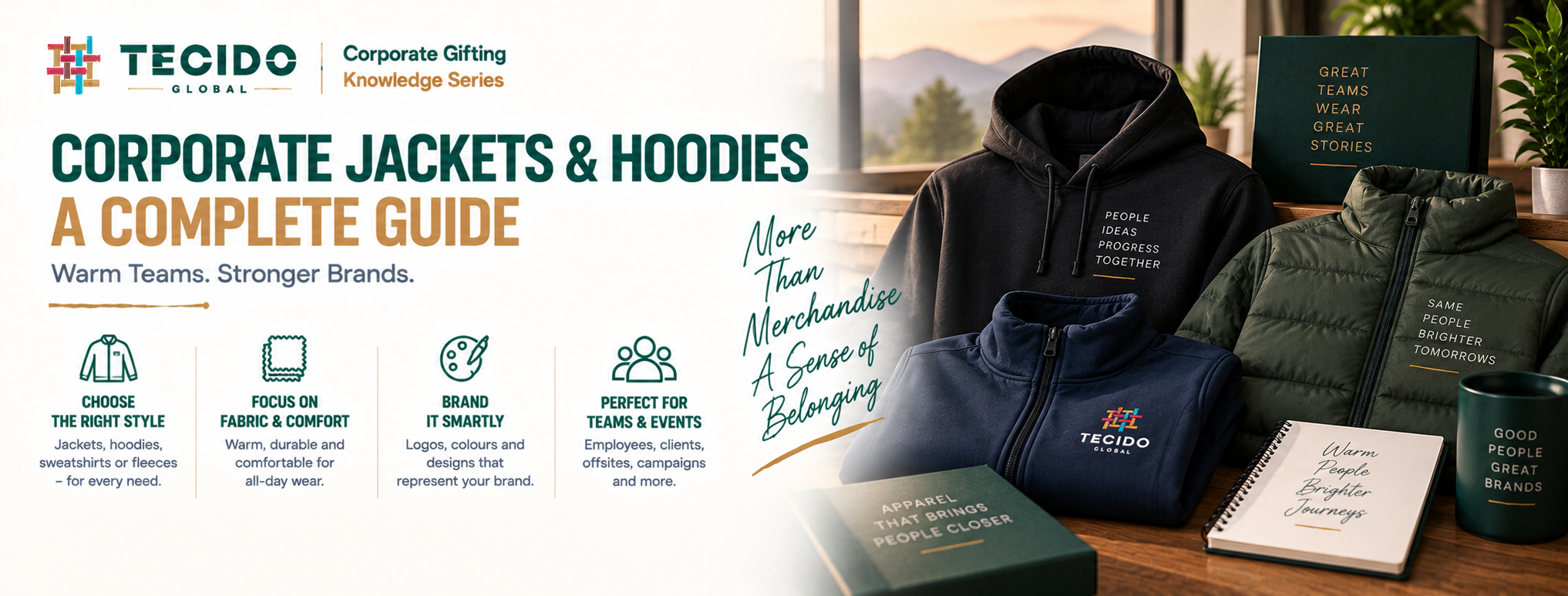
Corporate Jackets & Hoodies in India: Fabric, Branding, Sizing & Bulk Ordering Guide
Learn how to choose corporate jackets and hoodies in India, including fabric, GSM, fit, sizing, embroidery, printing, sampling and bulk-order planning.
Quick Answer
For corporate jackets and hoodies, start with climate, use case and fit. Approve fabric, GSM, colour, size chart and a physical sample before bulk production. Embroidery is strong for premium logos, while print or transfer methods can suit larger or more detailed graphics. Build a size buffer and allow more lead time than for standard merchandise.
Introduction
Corporate outerwear can create strong team identity because it is visible, wearable and repeatedly used. But apparel orders fail when buyers focus on the logo and ignore fabric, fit, climate and sizing. In India, a jacket for Bengaluru winter mornings, an air-conditioned office and a field team in North India may require three different constructions.
Choose the garment by use case
Lightweight zip jackets work for offices, travel and mild weather. Hoodies suit casual teams and events. Windcheaters and water-resistant shells are useful for field teams and monsoon-led programmes. Heavier winter jackets should be chosen only where climate justifies them.
Define whether the garment is uniform, event merchandise, onboarding apparel or a premium recognition gift.
Fabric, GSM and construction
Ask for fabric composition, GSM, lining, zipper quality, rib quality, shrinkage and wash-care information. Higher GSM does not automatically mean better quality; construction and fabric hand-feel matter.
For repeat programmes, document the approved specification so future batches remain consistent.
Sizing strategy for Indian teams
Use the supplier’s actual finished-garment size chart rather than generic S/M/L assumptions. Collect sizes with a deadline and keep a buffer in common sizes for exchanges and last-minute joiners.
If men’s and women’s fits differ, communicate the charts clearly. A sample-size set can reduce errors for large programmes.
Embroidery vs printing
Embroidery creates a premium, durable finish on polos, hoodies and jackets, especially for smaller chest logos. DTF or other print methods can handle detailed multi-colour artwork. Screen printing can be efficient for suitable fabrics and larger runs.
Always test the branding method on the actual garment because heat and needle tension can affect technical fabrics.
Sampling and quality control
Approve garment colour, fit, logo size, placement and finish on a pre-production sample. During QC, check stitching, zipper operation, measurement tolerance, stains, logo alignment and size labels.
For employee programmes, pack sizes clearly to reduce distribution errors.
Bulk-order planning
Apparel needs more planning than standard hard goods because size data, stock fragmentation and colour consistency create complexity. Lock quantities early and avoid major size revisions after branding begins.
For events, hold a modest buffer for speakers, organisers and size exchanges.
Tecido Global Expert View
For jackets and hoodies, comfort and fit determine whether the merchandise is actually worn. Tecido Global began with apparel manufacturing and white labelling, so we place particular emphasis on fabric, construction, size charts, trims and branding suitability. A heavy garment is not automatically a better garment; the right GSM and fabric depend on climate and use. We also recommend approving the actual garment across key sizes before production. If recipients enjoy wearing the apparel, the brand gets repeated visibility naturally—far more effectively than through oversized logos.
Frequently Asked Questions
What GSM is best for a corporate hoodie?
There is no single ideal GSM. Choose based on climate, fabric blend, intended use and desired hand-feel, then approve a physical sample.
Is embroidery better than printing on jackets?
Embroidery is excellent for premium small logos, but printing can be better for large or detailed graphics. The garment fabric determines what is suitable.
How many extra sizes should companies order?
Keep a practical buffer in the most common sizes based on workforce data and event uncertainty. The exact percentage depends on programme size and exchange policy.
How early should corporate jackets be ordered?
Earlier than simple ready-stock gifts. Sampling, size collection, branding and possible manufacturing all add lead time.
Conclusion
Successful corporate apparel begins with fit and fabric, not decoration. Approve the garment first, then choose a branding process that complements it and build enough time for sizing, sampling and quality control.
About Tecido Global
Tecido Global helps Indian companies curate and execute corporate gifting and custom merchandise programmes across employee engagement, onboarding, events, client gifting, leadership gifting and recognition. The approach combines sourcing, branding, packaging, quality control and delivery through one coordinated team.
Tecido Global
Your trusted partner for corporate gifting and branded merchandise. We are a team of passionate, creative individuals helping brands build stronger identities through thoughtful, high-quality merchandise that leaves a lasting impression. From concept to doorstep — end-to-end, on time, every single time.
Contact Info
- info@tecidoglobal.com
- (+91) 98924 67276
- (+91) 93213 02123
-
VERDE TECIDO GLOBAL LLP
20th Floor, Commerz II, Oberoi Garden City,
Off Western Express Highway, Goregaon (E),
Mumbai - 400063
GST: 27AAZFV9492L1ZP
MSME Reg.: UDYAM-MH-33-0649603


© 2026 Tecido Global | All Rights Reserved