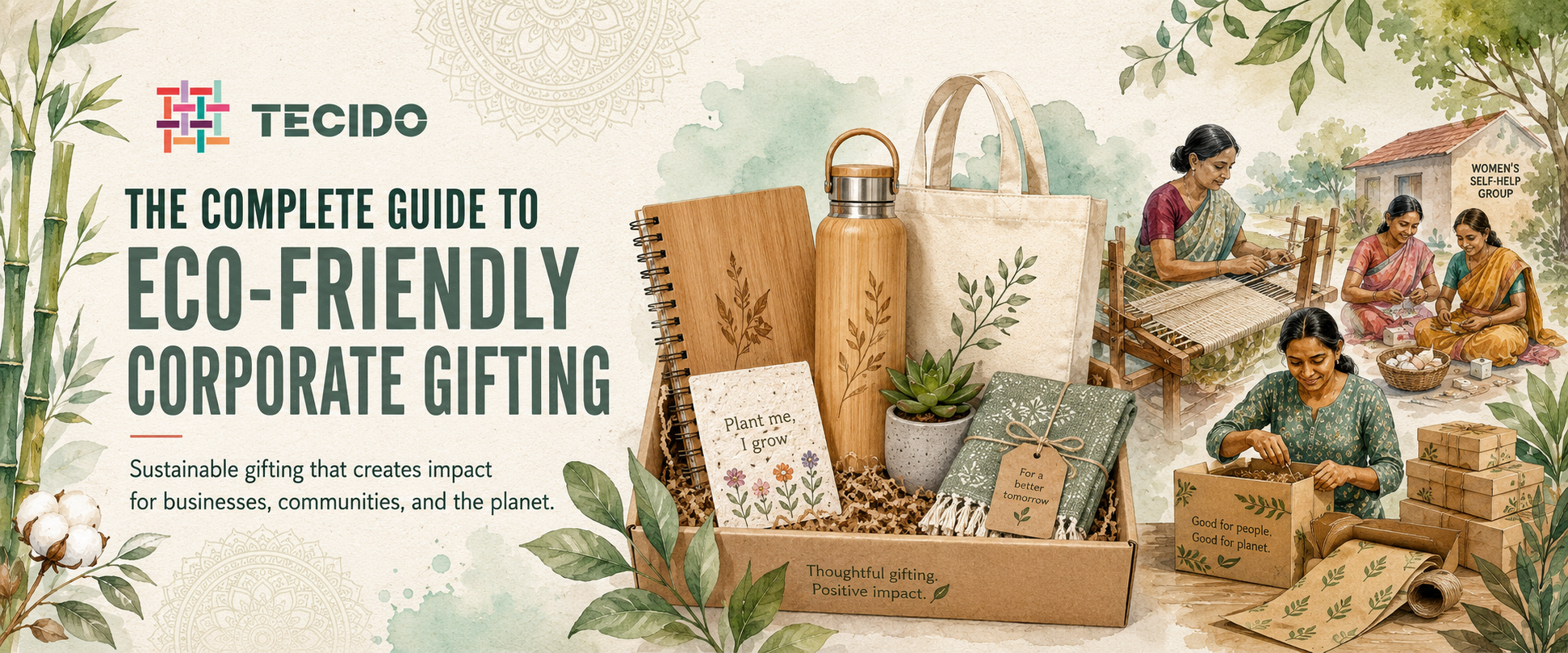
Complete Guide to Eco-Friendly Corporate Gifting
Sustainable gifting in India has moved from a niche preference to a boardroom conversation. Listed companies filing BRSR reports, MNCs meeting global ESG commitments, and organisations responding to younger workforces are all asking the same question: how do we gift in a way that reflects our values? This guide covers what eco-friendly gifting actually means, how to evaluate products rigorously, and how to build a programme that is genuinely responsible — not just labelled "green."
What "eco-friendly" really means in gifting
The term is applied loosely in the gifting industry. A rigorous approach evaluates sustainability across three dimensions:
• Environmental: materials, manufacturing processes, packaging, and end-of-life — what the product is made of and what happens to it after use
• Social: whether makers were paid fairly, worked safely, and — ideally — belong to marginalised communities that benefit from the income
• Longevity: whether the product lasts long enough to justify its production. A quality steel bottle used for five years is more sustainable than a cheap bamboo one that fails in six months
The most credible eco-friendly product categories
• Bamboo products: fast-growing, pesticide-free, biodegradable — ideal for desk accessories, cutlery sets, notebooks, and phone stands. Look for natural binders, not chemical resins
• Organic cotton apparel: GOTS-certified t-shirts, tote bags, and caps. Certification is visible, reportable, and verifiable — significantly stronger credentials than conventional cotton
• Jute and handloom: India-made, sustainable, and supportive of traditional industries. Particularly apt for companies with India-first or artisan values
• Recycled and upcycled materials: bags from recycled PET, upcycled denim, or reclaimed wood — growing category with strong storytelling potential
• Seed paper stationery: notebooks and cards that are planted after use to grow flowers or herbs — high delight factor and a powerful metaphor for growth
• NGO-made products: the deepest form of sustainability, addressing both environmental and social dimensions simultaneously. See our dedicated NGO gifting guide for details
Eco-friendly packaging: as important as the product
• FSC-certified or recycled cardboard for boxes — same quality as conventional, responsible sourcing
• Shredded recycled paper instead of bubble wrap or styrofoam
• Soy-based or water-based inks for all printing
• Seed paper or recycled paper for insert cards
• No single-use plastic of any kind, including cellophane wrapping on individual items
• Packaging designed to be reused — quality boxes that recipients keep rather than discard
Certifications to look for
• GOTS (Global Organic Textile Standard): for organic cotton and natural fibres — covers both material and processing
• FSC (Forest Stewardship Council): for paper and wood products — confirms responsible forest management
• Fair Trade Certified: confirms fair wages and safe working conditions in the supply chain
• Oeko-Tex Standard 100: confirms textiles are free of harmful substances
Documenting eco-gifting for ESG and BRSR reporting
Under SEBI's BRSR framework, eco-friendly gifting contributes to your supply chain sustainability disclosures. To make it count:
• Document environmental credentials of each gifting product in the programme
• Request and retain supplier certifications (GOTS, FSC, Fair Trade) for audit purposes
• Calculate and report total sustainable gifting spend as a percentage of your total gifting budget
• For NGO-sourced products, document the social impact metrics your NGO partner provides
Communicating your sustainable choices to recipients
The most sustainable gift is one whose story reaches the recipient. Include a card or insert explaining what the product is made from, any certifications it holds, the community or producer behind it, and what to do with the packaging after use. This transforms a product purchase into a values statement — and gives recipients a story worth sharing.
"True sustainability in gifting is not about finding a greener version of the same old thing. It is about rethinking what a gift can do — for the recipient, for the maker, and for the planet." — Priti Bhandari, Co-Founder, Tecido Global
Tecido curates sustainable gifting programmes for B2B companies across India. Contact us at info@tecidoglobal.com.
Tecido Global
Your trusted partner for corporate gifting and branded merchandise. We are a team of passionate, creative individuals helping brands build stronger identities through thoughtful, high-quality merchandise that leaves a lasting impression. From concept to doorstep — end-to-end, on time, every single time.
Quick Links
Contact Info
- info@tecidoglobal.com
- (+91) 98924 67276
- (+91) 93213 02123
-
VERDE TECIDO GLOBAL LLP
20th Floor, Commerz II, Oberoi Garden City,
Off Western Express Highway, Goregaon (E),
Mumbai - 400063
GST: 27AAZFV9492L1ZP
MSME Reg.: UDYAM-MH-33-0649603


© 2026 Tecido Global | All Right Reserved