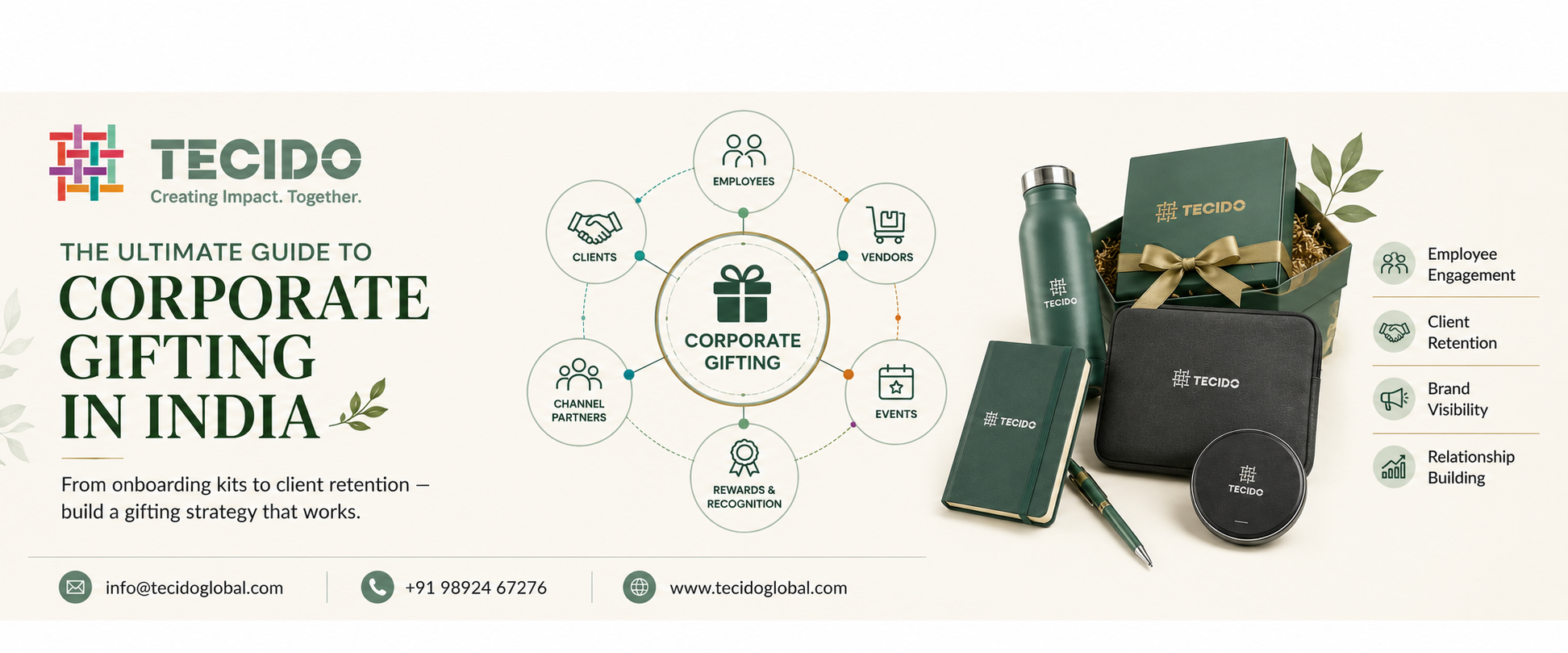
The Ultimate Guide to Corporate Gifting in India for Companies
Corporate gifting in India has evolved from a seasonal courtesy into a strategic business tool worth ₹14,000 crore annually. Yet most companies approach it reactively — a Diwali hamper here, a new joiner kit there — without a coherent strategy behind it.
This guide covers everything a company in India needs to know about corporate gifting: what it is, why it matters, how to plan it, and how to make every rupee spent count.
What is corporate gifting?
Corporate gifting is the practice of giving gifts to employees, clients, vendors, partners, and other stakeholders to build relationships, express appreciation, and strengthen brand identity.
In India, corporate gifting broadly falls into two categories::
• Internal gifting: Gifts for employees during onboarding, work anniversaries, festivals, achievements, and life milestones.
• External gifting: Gifts for clients, prospects, channel partners, vendors, and other business stakeholders.
Why corporate gifting matters in B2B India
Strategic gifting delivers measurable business benefits:
• Companies with structured gifting programmes report 12–15% higher employee satisfaction scores
• Emotionally engaged B2B clients contribute 23% more revenue than average clients (Gallup)
• 85% of gift recipients report better feelings toward the gifting brand (PPAI research)
• Branded merchandise generates an average of 344 impressions over its lifetime
In India, gifting also carries cultural significance. It signals respect, appreciation, and relationship investment. A thoughtful gift often creates stronger connections than multiple meetings or emails.
The gifting occasions every company should plan for
Employee gifting occasions
• New hire onboarding — the most impactful first impression your company can make
• Work anniversaries — 1, 3, 5, and 10 year milestones
• Promotions and achievements
• Diwali, Holi, and other significant festivals
• Life events — marriage, parenthood, recovery from illness
• Farewell — an often-overlooked occasion that shapes brand perception for years
Client and partner gifting occasions
• New client welcome — before or on the first day of engagement
• Contract renewal — the 30 days before a renewal is your highest-stakes gifting window
• Project completion — acknowledging shared achievement
• Client-side promotions and milestones
• Diwali and New Year — the two biggest B2B gifting occasions in India
• Vendor and channel partner appreciation — often overlooked, always effective
The gifting planning framework: four questions to answer first
1. Who is the recipient? — their seniority, role, relationship depth, and personal preferences shape everything
2. What is the occasion? — a new hire kit requires different thinking than a client retention gift
3. What is the budget? — set per-person budgets by relationship tier before choosing products
4. What story should the gift tell? — every gift communicates something about your brand. What do you want it to say?
Building a gifting tier framework
The most successful gifting programmes use a tiered structure:
• Tier 1 (₹3,000–₹10,000): strategic clients, senior employees, long-term partners — bespoke, premium, highly personalised
• Tier 2 (₹1,500–₹3,000): growth accounts, mid-level employees, key contacts — quality products, personalised packaging
• Tier 3 (₹500–₹1,500): all-employee festivals, event giveaways, maintained accounts — standardised but never cheap
Choosing the right products
The best corporate gifts share four characteristics:
1. Utility — they are used regularly, keeping your brand visible in daily life
2. Quality — they reflect the standard of your company. A poor-quality gift creates a negative association
3. Appropriateness — they suit the recipient, the occasion, and the relationship
4. Personalisation — at minimum, a personalised card; ideally, the recipient's name on the product itself
The highest-performing gift categories in Indian corporate gifting: premium drinkware (bottles, tumblers), tech accessories (chargers, cable organisers, laptop sleeves), quality stationery sets, branded apparel, wellness kits, and — increasingly — NGO-made artisan products.
The role of customisation and branding
Every corporate gift is a branded touchpoint. Customisation techniques include screen printing, embroidery, laser engraving, UV printing, embossing, and sublimation — each suited to different products and finishes.
Key principle: branding should enhance the gift, not overpower it. Subtle branding often creates a more premium impression than oversized logos.
Packaging: the first gift
Packaging shapes the recipient's first impression before they even see the product.Rigid gift boxes, tissue paper, personalised insert cards, and branded sleeves elevate the experience significantly and increase the likelihood of social sharing.
A great gift deserves great packaging.
Planning the gifting calendar
The most effective gifting programmes are planned well in advance.
- Diwali gifting: start planning 8–10 weeks ahead.
- Events and conferences: plan 6–8 weeks in advance.
- Employee milestone programmes: automate wherever possible.
A yearly gifting calendar helps avoid last-minute decisions, delays, and unnecessary costs.
Measuring the impact
Track: employee NPS before and after gifting programme implementation; client renewal rates year-on-year; feedback from gift recipients (a simple one-question survey sent 3 days after delivery works well); and social sharing rates for significant gifting campaigns.
"Corporate gifting done well is not an expense — it is relationship infrastructure. And in B2B India, relationships are the foundation of everything." — Priti Bhandari, CEO, Tecido Global
Ready to build a strategic gifting programme? Contact Tecido at info@tecidoglobal.com or +91 98924 67276.
Tecido Global
Your trusted partner for corporate gifting and branded merchandise. We are a team of passionate, creative individuals helping brands build stronger identities through thoughtful, high-quality merchandise that leaves a lasting impression. From concept to doorstep — end-to-end, on time, every single time.
Quick Links
Contact Info
- info@tecidoglobal.com
- (+91) 98924 67276
- (+91) 93213 02123
-
VERDE TECIDO GLOBAL LLP
20th Floor, Commerz II, Oberoi Garden City,
Off Western Express Highway, Goregaon (E),
Mumbai - 400063
GST: 27AAZFV9492L1ZP
MSME Reg.: UDYAM-MH-33-0649603


© 2026 Tecido Global | All Right Reserved